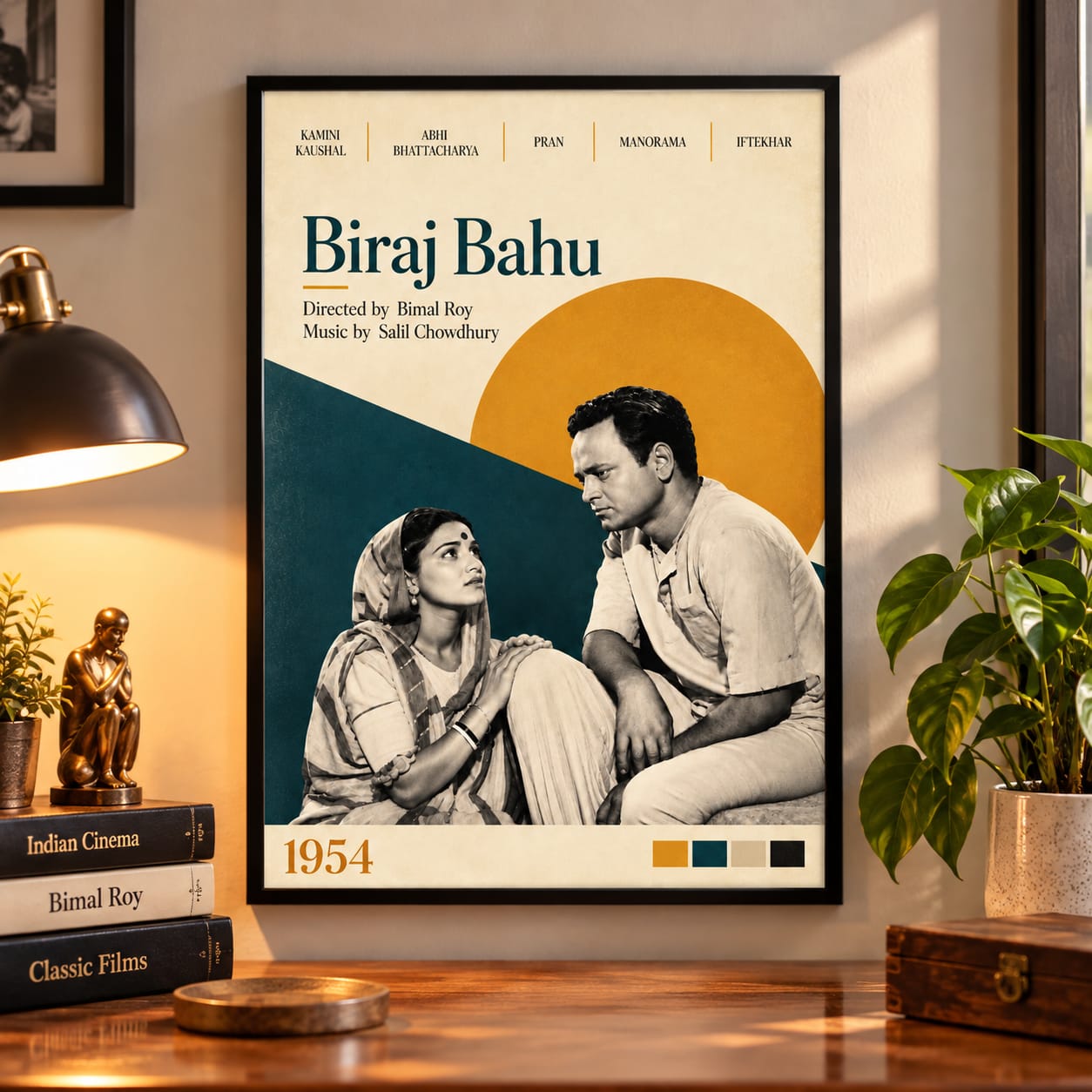
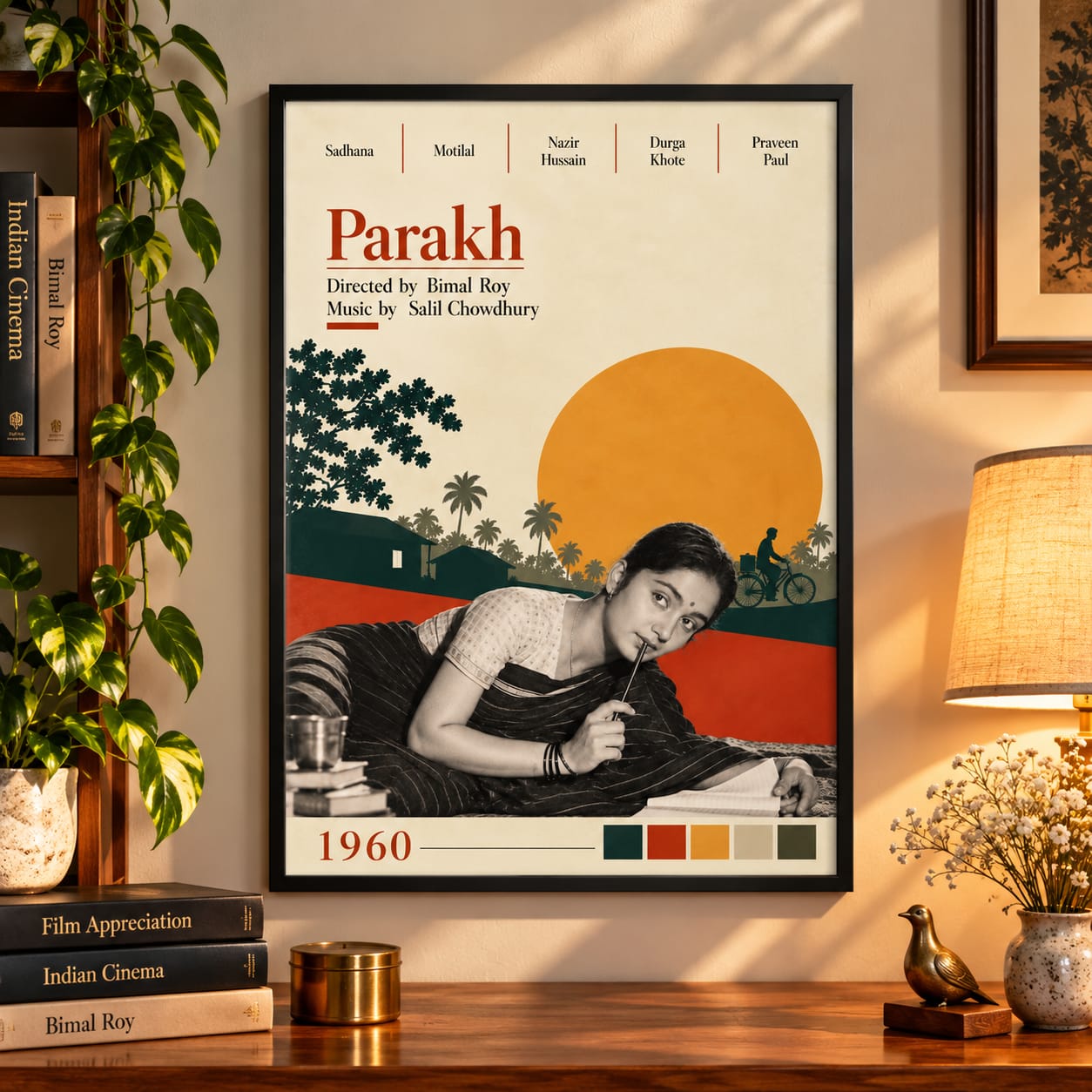
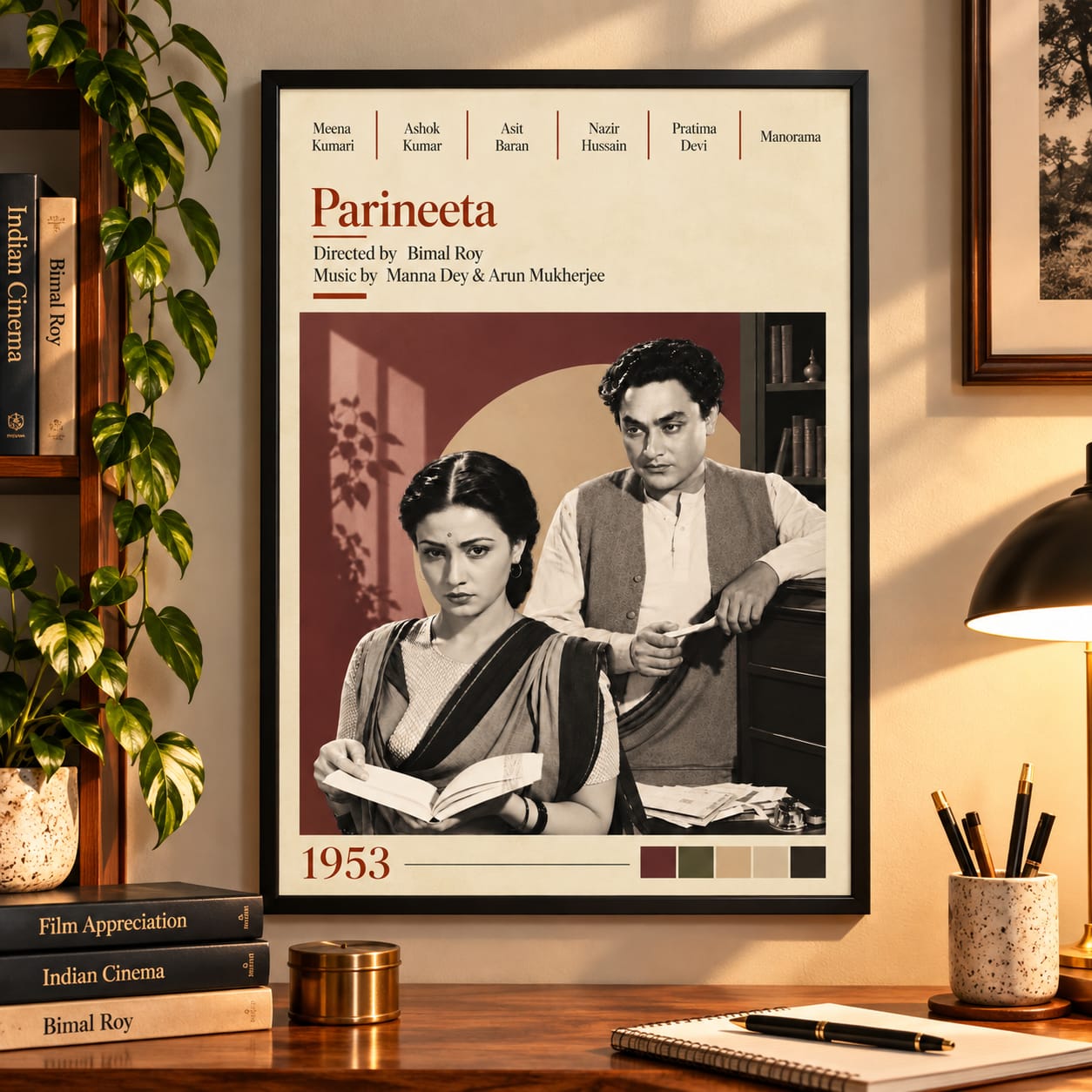
This contemporary vintage-inspired poster for Bimal Roy’s Biraj Bahu places Biraj and Nilambar at its emotional centre. Rather than illustrating every dramatic turn of the film, the artwork concentrates on the quiet intimacy between a husband and wife whose love is repeatedly tested by poverty, circumstance, misunderstanding and social vulnerability.
Biraj sits close to Nilambar, her hands resting gently as she looks upward toward him. Nilambar appears more troubled and inward-looking. The contrast captures an essential quality of their relationship: Biraj’s love is intensely personal and unwavering, while Nilambar’s affection exists alongside his idealism, simplicity and difficulty in protecting their household from material hardship.
Artwork note: This is a contemporary artistic reimagining inspired by the film, not an original 1954 theatrical poster.
Biraj — Love, Pride and Quiet Strength
Biraj, played by Kamini Kaushal, is the emotional soul of the film. Her devotion to Nilambar is central to her character, but she is more than a passive portrait of a dutiful wife. When the household falls into poverty, she quietly takes responsibility for its survival and tries to preserve dignity even as life becomes increasingly unforgiving.
That is why the poster gives Biraj such a strong emotional presence. Her upward gaze can be read not simply as dependence, but as faith — faith in the man she loves and in the bond they have built together.
Nilambar — A Good Man in an Unforgiving World
Nilambar, played by Abhi Bhattacharya, is a decent, spiritual and selfless man. He is compassionate and respected, yet he is not especially worldly or materially minded. His goodness does not always equip him to confront the economic and social pressures threatening his home.
Nilambar’s weakness is not an absence of love for Biraj. He loves her deeply, but the world around them demands practical strength as well as goodness. The poster therefore presents him as serious and burdened rather than conventionally romantic — a man whose affection is genuine even when love alone cannot solve every problem.
Biraj & Nilambar — A Marriage Tested by Life
At its heart, Biraj Bahu is concerned with what happens to love when life begins stripping away security. Biraj and Nilambar do not begin as strangers learning to love one another. Their tragedy is that they already love each other deeply.
Their relationship is tested not by an absence of affection, but by poverty, family conflict, vulnerability and eventually suspicion and misunderstanding. As their circumstances worsen, the outside world begins to intrude upon the private trust of their marriage. This is what makes their relationship so poignant: the love is genuine, yet the world surrounding that love is fragile.
The Golden Sun and Deep-Teal Divide
The composition deliberately removes most secondary characters and places Biraj and Nilambar alone together. The enormous mustard-gold circle behind them suggests warmth, home and the emotional completeness their marriage once represented. Its setting-sun quality also introduces melancholy — the sense that the peaceful world they know may be slipping away.
The broad deep-teal diagonal cuts dramatically across the image. It can be read as the pressure of circumstance entering their marriage: poverty, social inequality, family obligations and forces beyond their control. Yet Biraj and Nilambar remain physically close. Their expressions differ, but the composition keeps them within the same intimate emotional space.
The Meaning Behind the Artwork
Bimal Roy’s film transforms an intimate marriage into a larger reflection on love, dignity, poverty, sacrifice and the vulnerability created by unequal social structures. The poster preserves that intimacy rather than attempting to dramatize every turn of the story.
At its centre is a simple emotional idea: Biraj’s greatest source of strength is her love for Nilambar, and Nilambar’s deepest emotional bond is with Biraj. Their tragedy lies not in the absence of love, but in how severely that love is tested by the world around them.
Their love is not fragile because it is weak — it is poignant because the world around it is.