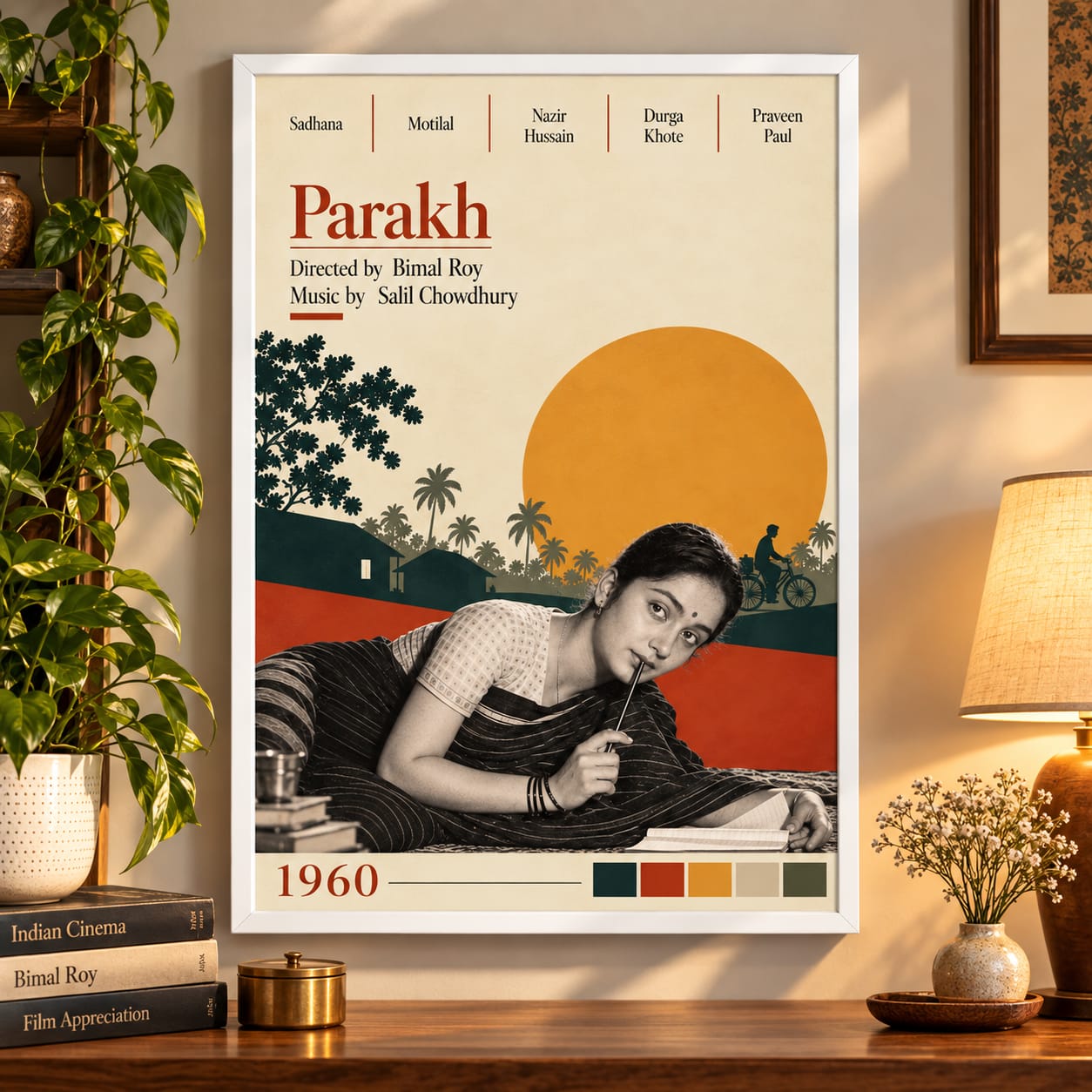
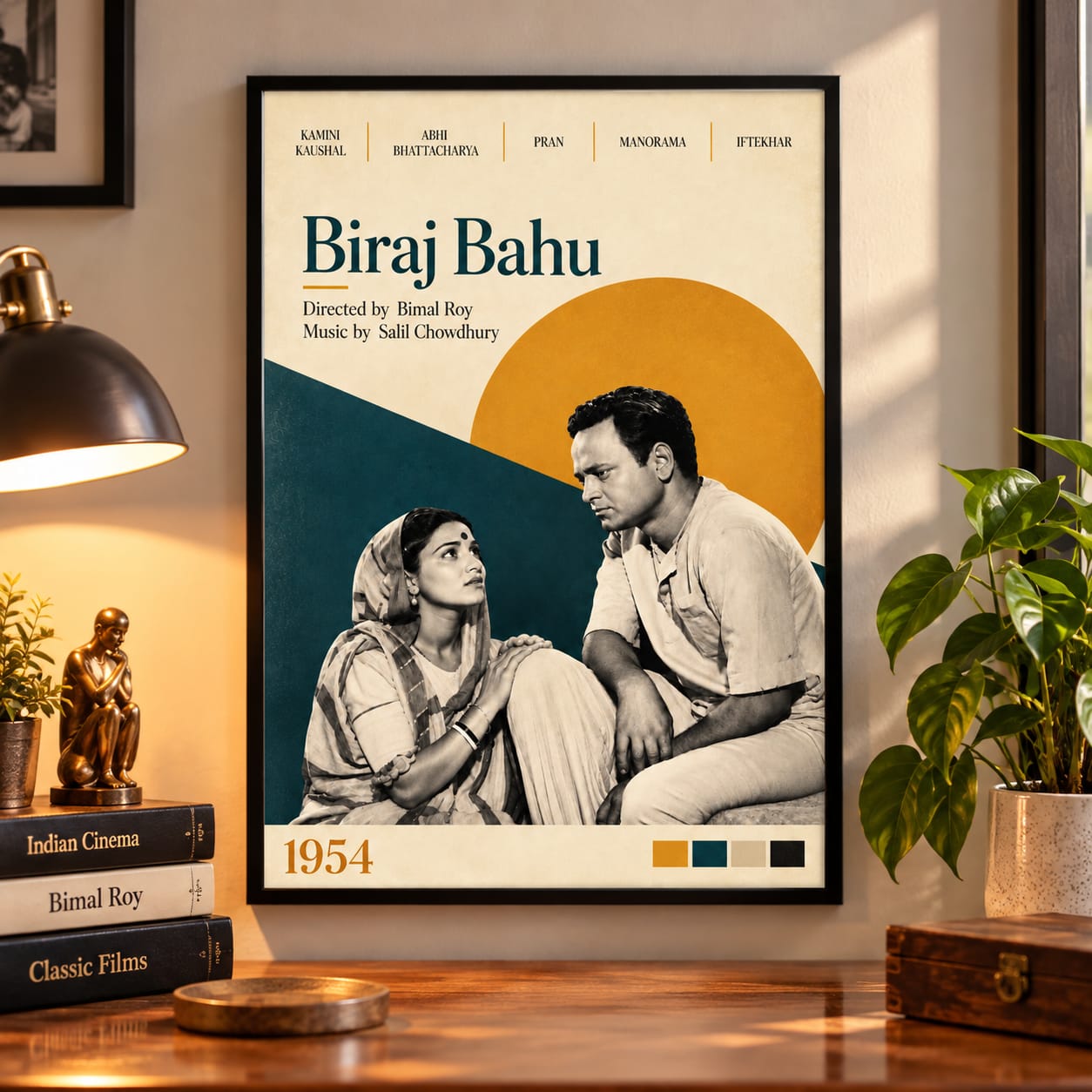
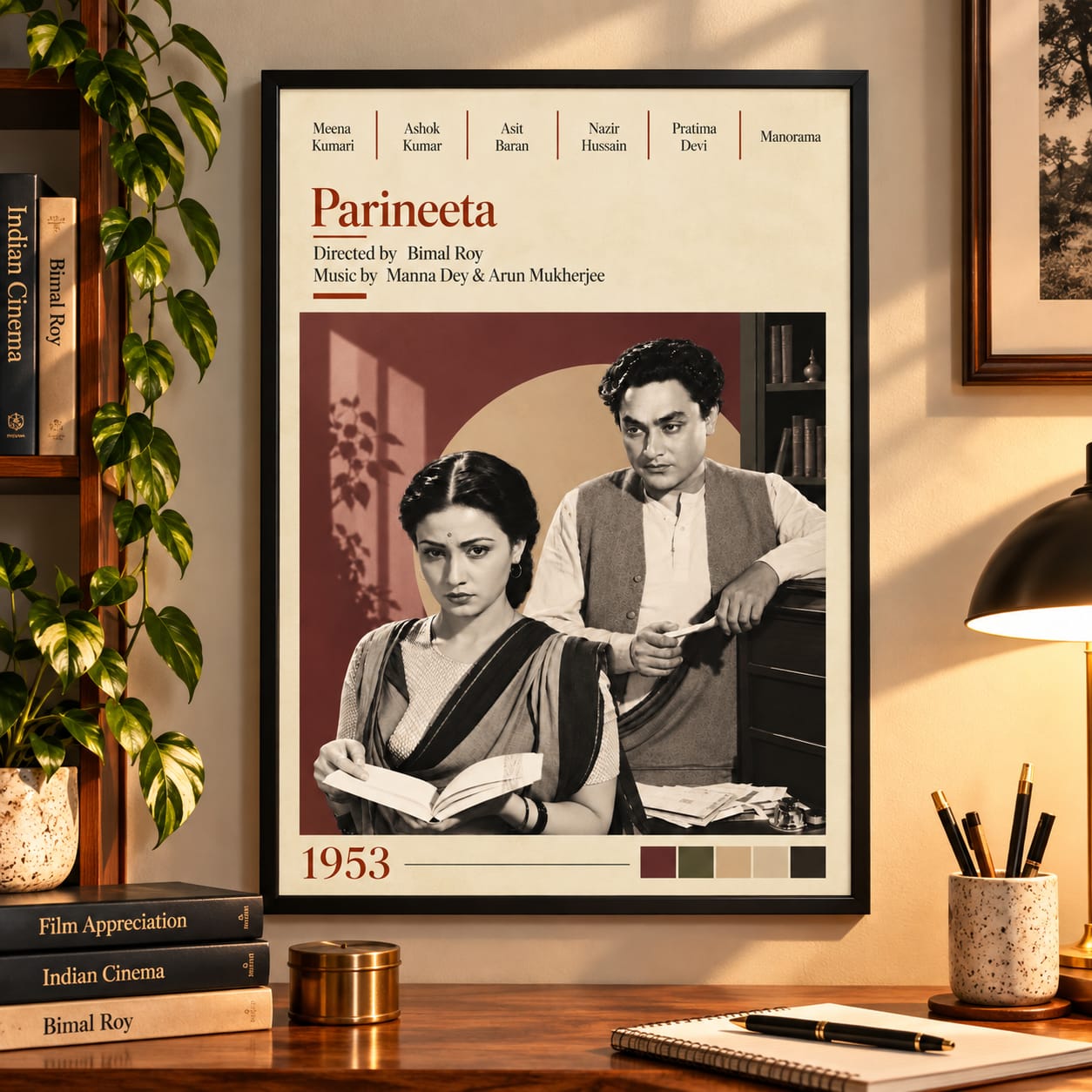
This contemporary reimagining of Bimal Roy’s Parakh places Seema, played by Sadhana, at the centre of a deceptively peaceful village world. Seema is the daughter of Nivaran, the village postmaster. Her quiet, thoughtful pose with a notebook and pen brings warmth and intimacy to a story concerned with money, status, honesty and public morality.
Behind her, simple village houses, palms and open land stretch beneath an enormous golden sun. A lone postman rides through the landscape. That small figure is crucial: Haradhan, played by Motilal, is actually Sir Jagdish Chandra Roy in disguise, quietly observing the villagers and testing the character of those who hope to be entrusted with a large donation intended for the village’s welfare.
Artwork note: This is a contemporary artistic reimagining inspired by the film, not an original 1960 theatrical poster.
Seema - The Quiet Heart of the Village
Seema belongs to the postmaster’s modest household, away from the village’s competition for prestige. Her affection for the idealistic schoolteacher Rajat gives Parakh its tender romantic thread. In this artwork, her reflective expression represents the private, human world of the film - family, affection, uncertainty and hope - while the village around her prepares for a very public test of virtue.
Haradhan - The Man Who Watches
The postman Haradhan appears ordinary and even pretends to be lame, but he is secretly Sir Jagdish Chandra Roy. Rather than judging the village from a position of wealth and authority, he moves quietly among its people. He visits and observes the possible candidates, seeing how they behave when they believe the money might come to them.
This is why the cyclist in the poster is intentionally small. The man whom powerful people may overlook is, in fact, the person conducting the real parakh - the examination of their honesty.
The Cheque - A Test Disguised as a Gift
A cheque for five lakh rupees arrives with instructions that it should be placed in the hands of an honest person who will use it for the welfare of the village. Once the possibility of receiving the money becomes public, several influential villagers suddenly become unusually generous and public-spirited. Their transformation gives the film much of its humour, but it also exposes an uncomfortable question: are they doing good because they are good, or because they want to be seen as good?
Bimal Roy’s Message - The Real Meaning of Parakh
The title Parakh means a test, an examination or a way of judging true worth. Bimal Roy turns the promised money into a moral test for an entire community. Through gentle satire, the film questions the distance between reputation and character, between public promises and private motives, and between genuine service and virtue performed for reward.
The film also uses the village election to reflect on democracy itself. A vote can identify the most popular or persuasive candidate, but popularity is not automatically the same as integrity. The deeper test lies in what a person does when there is no audience, no applause and no obvious reward.
That idea gives the poster its meaning. Seema remains absorbed in her own quiet world while Haradhan travels through the village in the background. Around them are ordinary homes and ordinary lives, yet an extraordinary test is taking place. The real measure of a person, the film suggests, is not wealth, position or a sudden display of generosity - it is the character revealed through everyday actions.
Parakh asks a simple question: when goodness brings no reward, who still chooses to be good?
Customer Feedback
0 Reviews
No Reviews Yet
Have you used this product? Be the first to share your thoughts!
Have You Purchased This?
Please log in to your account to write a verified customer review.
Login to Review