0
Wishlist
0
Cart





(BC-1793447628840-322)
| Paper Size | CM | Inches | Feet |
|---|---|---|---|
| A4 | 21 × 29.7 | 8.3 × 11.7 | 0.69 × 0.98 |
| A3 | 29.7 × 42 | 11.7 × 16.5 | 0.98 × 1.38 |
| A2 | 42 × 59.4 | 16.5 × 23.4 | 1.38 × 1.95 |
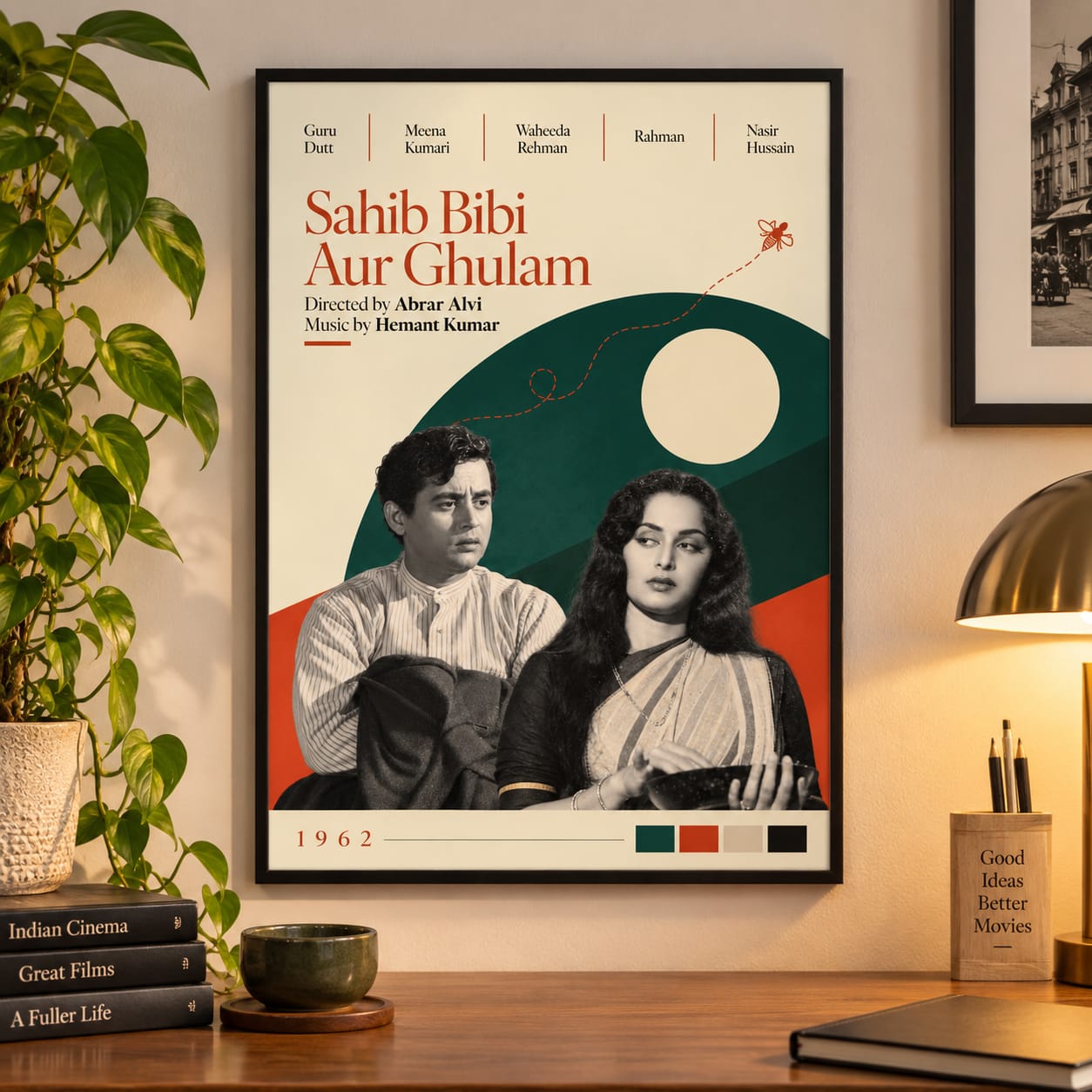
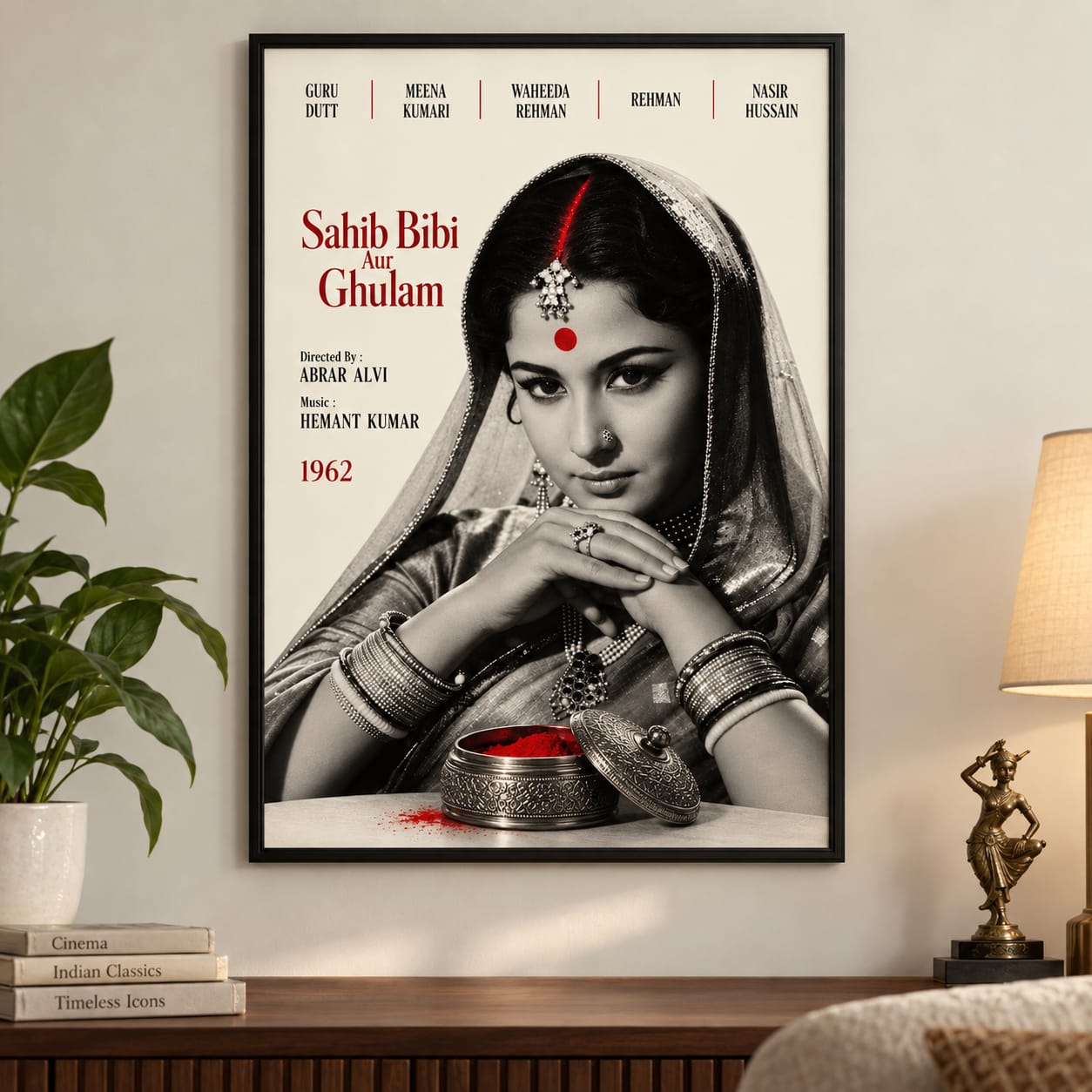
A tribute to one of Hindi cinema’s most haunting portraits of a disappearing world, this poster brings together the three emotional poles of Sahib Bibi Aur Ghulam: the Sahib, the Bibi and the Ghulam. The composition is not intended as a reproduction of an original 1962 theatrical one-sheet; it is a contemporary, vintage-inspired interpretation created for modern interiors and collectors of classic Indian cinema.
At the centre is Chhoti Bahu, a woman trapped inside the splendour and suffocation of the haveli. Beside her is her husband, Chhote Babu — the Sahib — whose nights away from home become the source of her deepest loneliness. The intimate gesture of drink in the composition recalls Chhoti Bahu’s tragic attempt to enter her husband’s world: she breaks the rules imposed upon a respectable daughter-in-law, hoping that by drinking with him she can hold him close and keep him away from the courtesan’s quarters.
The third presence is Bhootnath — the Ghulam, played by Guru Dutt — the outsider who enters the haveli in his youth and becomes a quiet witness to Chhoti Bahu’s longing. His story gives the poster another dimension: the haveli is not only a place of passion and confinement, but also a memory. Years later, the young Ghulam has become a trained engineer, and the magnificent household he once knew has fallen into ruin.
Chhote Babu belongs to a declining aristocratic household in which wealth, status and male privilege dictate the rhythm of life. For Chhoti Bahu, however, the grandeur of the haveli offers no protection from emotional abandonment. She does not ask merely for jewels or position; she wants the companionship of her husband. When conventional devotion fails to bring him home, she attempts the unthinkable for a woman of her station: she agrees to drink with him, hoping to become the companion he seeks elsewhere.
Meena Kumari’s Chhoti Bahu is the emotional heart of the film. Her drinking is not presented here as glamour; it is the visual symbol of a desperate bargain. She crosses the boundaries of the zenana and of respectable womanhood because she believes love may still be recovered. Each compromise is made in the hope of intimacy, yet the very act meant to bring her husband closer becomes part of her destruction. The glass in the poster therefore carries two meanings at once: an offering of love and the beginning of tragedy.
Guru Dutt’s Bhootnath is the “Ghulam” of the title. In his younger life he arrives in Calcutta as a naïve but educated villager seeking work and finds himself drawn into the strange, fading universe of the Chaudhury haveli. He is neither its master nor one of its privileged inhabitants. He stands at its margins — humble, observant and emotionally open — and this is precisely why Chhoti Bahu is able to speak to him with a vulnerability that the haveli itself does not permit.
Bhootnath becomes more than a servant-like outsider: he becomes the witness and keeper of Chhoti Bahu’s memory. He sees the woman behind the title of “Bibi” — her loneliness, dignity, hope and gradual collapse. The Ghulam cannot rescue her from the social order that imprisons her, but he carries the memory of her long after that order has begun to disappear.
The film is framed through an older Bhootnath, now an engineer, returning to the site of the once-grand haveli as it is being demolished. The contrast is devastating: the rooms that once held music, ritual, wealth, cruelty and whispered confidences have become rubble. During the demolition, human remains are discovered, and a piece of jewellery reveals the terrible implication that they are Chhoti Bahu’s.
For Bhootnath, the ruins are therefore not merely architecture. They are the remains of a life he witnessed and could not save. The young Ghulam had listened to Chhoti Bahu’s longing; the older Bhootnath is left to confront what remains of her. His pain turns the collapse of the haveli into something larger — the death of a social world and the persistence of personal memory after wealth, status and power have vanished.
Have you used this product? Be the first to share your thoughts!
Please log in to your account to write a verified customer review.
Login to Review