Some romances are most beautiful when they exist only in a dream.
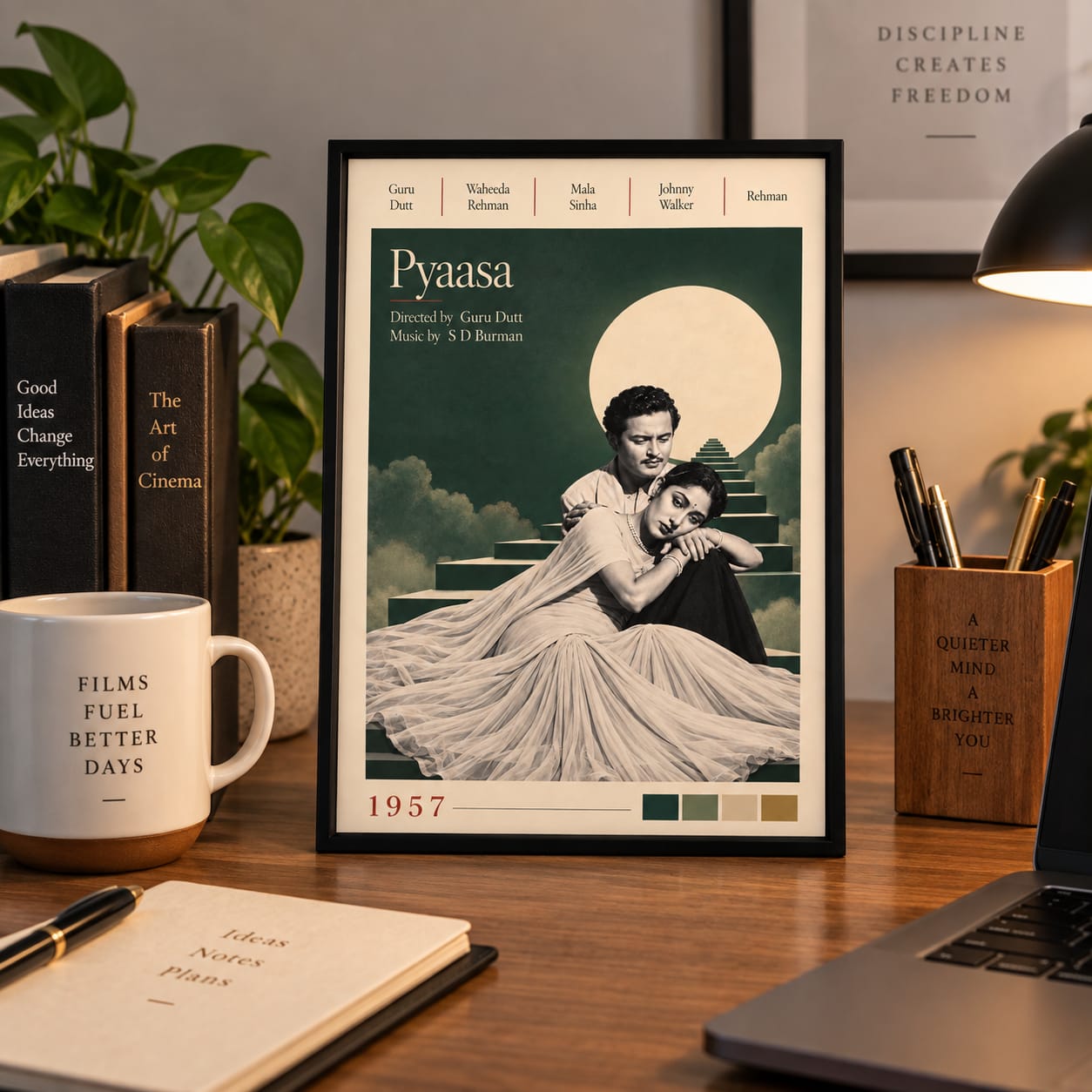
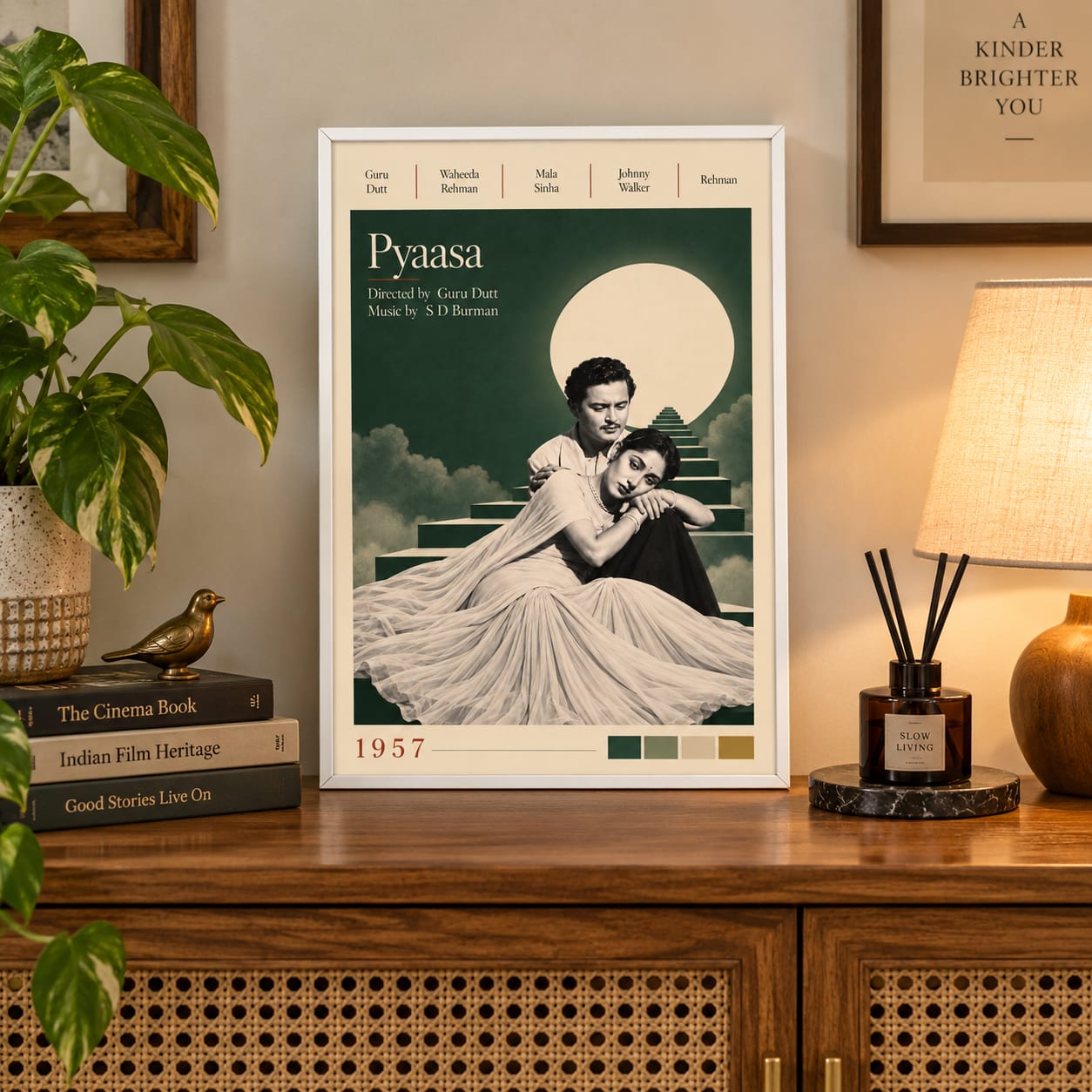
This Pyaasa art poster is inspired by the dreamy romantic interlude of “Hum Aapki Aankhon Mein,” a rare moment in Guru Dutt’s otherwise deeply melancholic 1957 film. The artwork imagines Vijay and Meena suspended in the tenderness of their younger love: close to one another, removed from the pressures of the world, and surrounded by a surreal staircase rising toward a luminous moon.
The soft monochrome figures contrast with the deep green setting, while the receding steps suggest a romance climbing toward an impossible place. Warm ivory and rust-orange accents preserve the mid-century character of the collection. The result is not simply a romantic poster; it is a visual memory of love as Vijay wishes it could have remained.
Before disappointment and compromise enter their lives, Vijay and Meena share the innocence of young love. Pyaasa remembers their college-day romance through a brief flashback, revealing that the weary poet seen later in the film was once capable of lightness, hope and uncomplicated affection.
“Hum Aapki Aankhon Mein” turns that feeling into fantasy. Vijay and Meena appear inside a romantic dream world, momentarily untouched by money, status, ambition or social expectation. Their playful exchange belongs to an imagined space where love alone seems sufficient. The sequence offers a rare glimpse of happiness in a film that steadily moves toward disillusionment.
But Pyaasa does not allow the dream to become reality. When Vijay meets Meena again, she has married the wealthy publisher Mr. Ghosh. Their youthful romance has been replaced by the compromises and inequalities of adult life. Vijay remains emotionally wounded; Meena has chosen security. What once felt effortless now exists mainly as memory.
That contrast is the heart of this poster: the staircase leads upward, the moon glows ahead, and the lovers appear beautifully sheltered from the world — yet the viewer already knows that the dream cannot last.