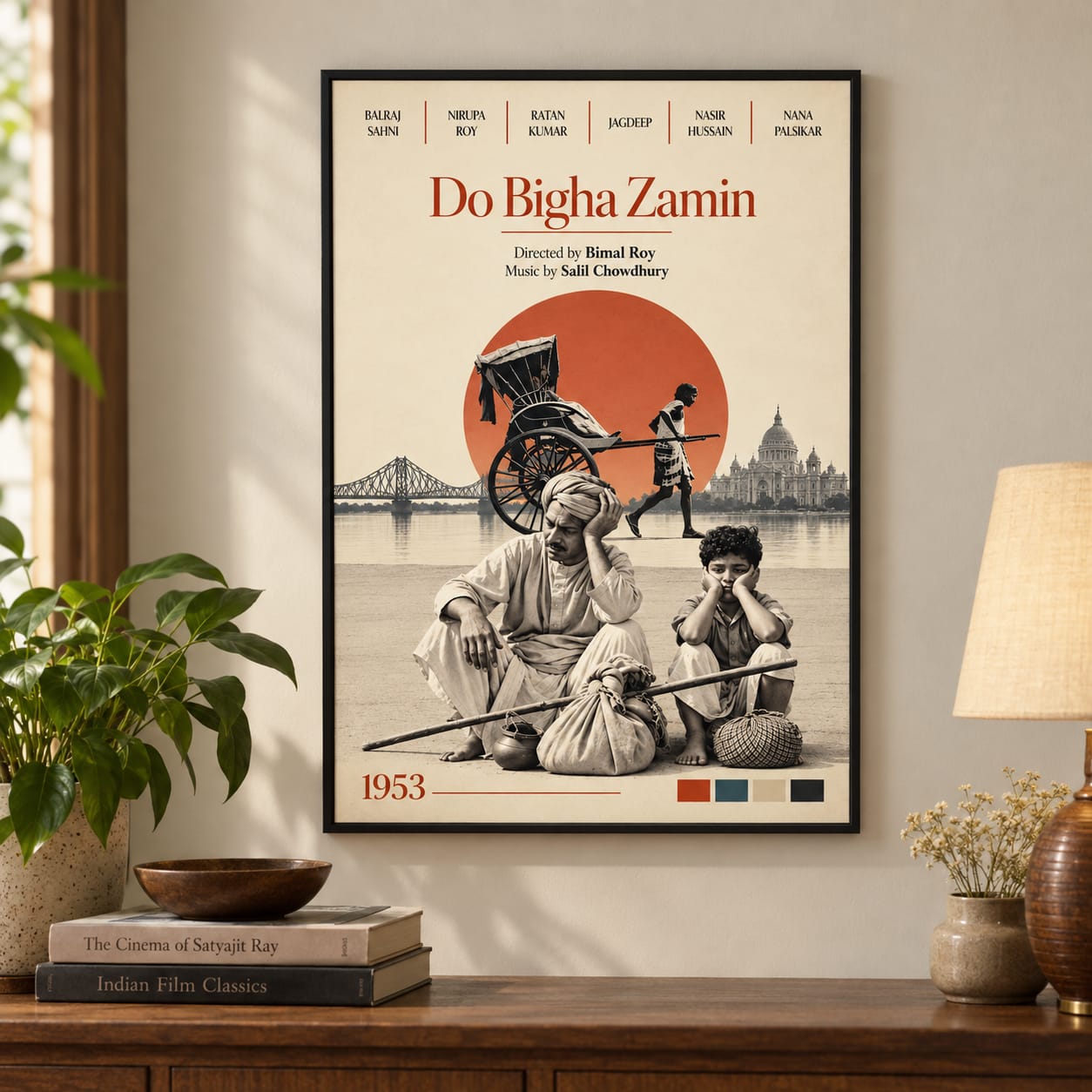
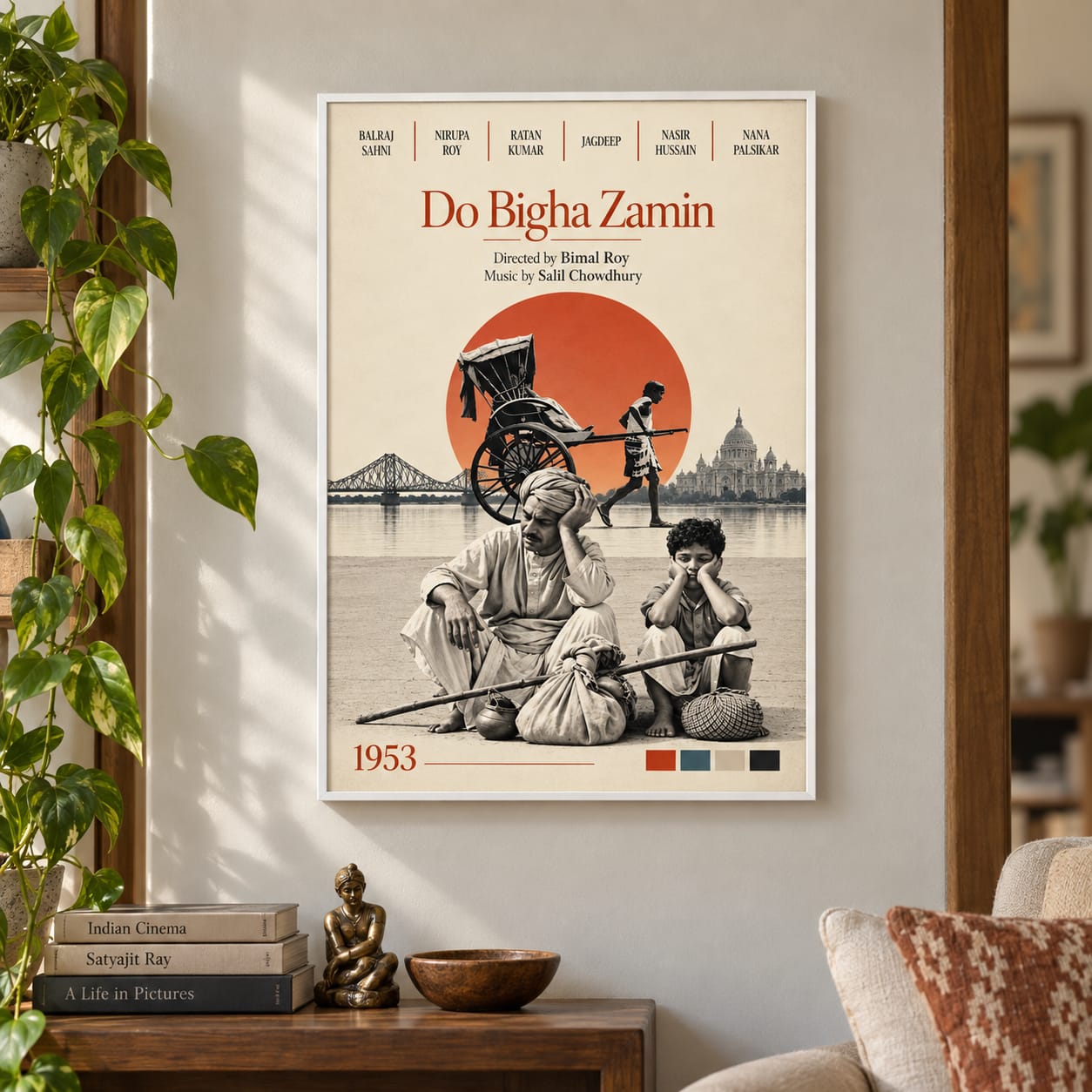
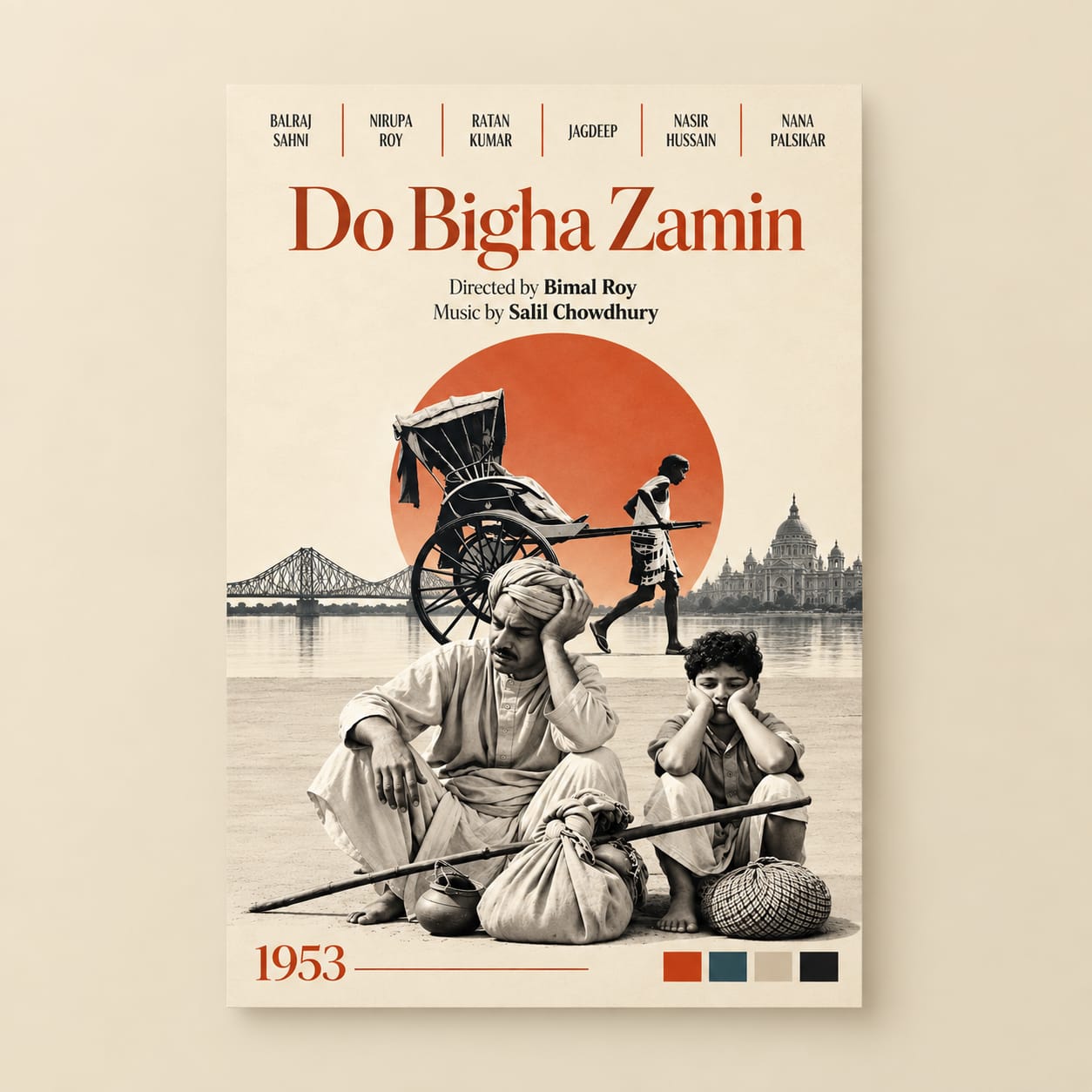
This poster interprets Do Bigha Zamin through a clean, classic visual language rather than recreating an original theatrical one-sheet. The warm cream field and rust-red circular form give the design the patina of a mid-century print, while the largely black-and-white imagery keeps the emotional weight on the people rather than on decoration.
At the centre is the image of Shambhu, played by Balraj Sahni, seated beside his son with their few belongings gathered around them. Above them, the hand-pulled rickshaw becomes the defining symbol of Shambhu’s life in Kolkata: the farmer who once worked his own soil must now pull another person through the city in the hope of earning enough to save his land.
The distant Howrah Bridge and colonial-era Kolkata architecture establish the city without overwhelming the figures. The result is deliberately spare and reflective — a poster about labour, displacement, dignity and the painful distance between home and survival.
Two bighas — a small piece of land, an entire world
Shambhu is a poor Bengali farmer whose family’s security rests on a small holding of land. When a landlord seeks the property for industrial development and an old debt threatens his claim to it, Shambhu is given only a short time to raise the money needed to protect his home. The stakes are modest in acreage but enormous in human terms: those two bighas represent livelihood, memory, identity and belonging.
From farmer to rickshaw puller
Shambhu travels to Kolkata to earn money, with his young son eventually sharing the hardship of city life. The city offers work, but not relief. Shambhu becomes a hand-pulled rickshaw puller, exchanging the physical labour of cultivation for the punishing labour of hauling passengers through crowded streets. In the poster, the rickshaw is enlarged against the rust-red disc so that it reads almost like a second fate hanging over the seated father and son.
Why the father and son sit in the foreground
The foreground is intentionally quiet. Shambhu’s bent posture and the child’s downcast stillness are set against their bundled possessions, a pot and a long staff — simple objects that suggest how little separates a settled life from displacement. Their pause gives the poster its emotional centre: not spectacle, but exhaustion, uncertainty and the stubborn wish to return home.
The city behind them
Kolkata appears as both destination and obstacle. The bridge, monumental architecture and rickshaw silhouette create a cityscape of scale and movement, while Shambhu and his son remain intensely human and vulnerable below it. The contrast echoes the film’s wider concern with a rapidly modernising India in which rural families could be pushed to the margins by debt, industrialisation and unequal power.
A classic remembered through restraint
Rather than illustrating every turn of the narrative, this artwork compresses the film into a few recurring symbols: land, labour, the city, the rickshaw, a father and his child. The limited palette and generous negative space are designed to feel timeless — a contemporary tribute to a film whose emotional force comes from ordinary people facing extraordinary pressure with dignity.
Customer Feedback
0 Reviews
No Reviews Yet
Have you used this product? Be the first to share your thoughts!
Have You Purchased This?
Please log in to your account to write a verified customer review.
Login to Review