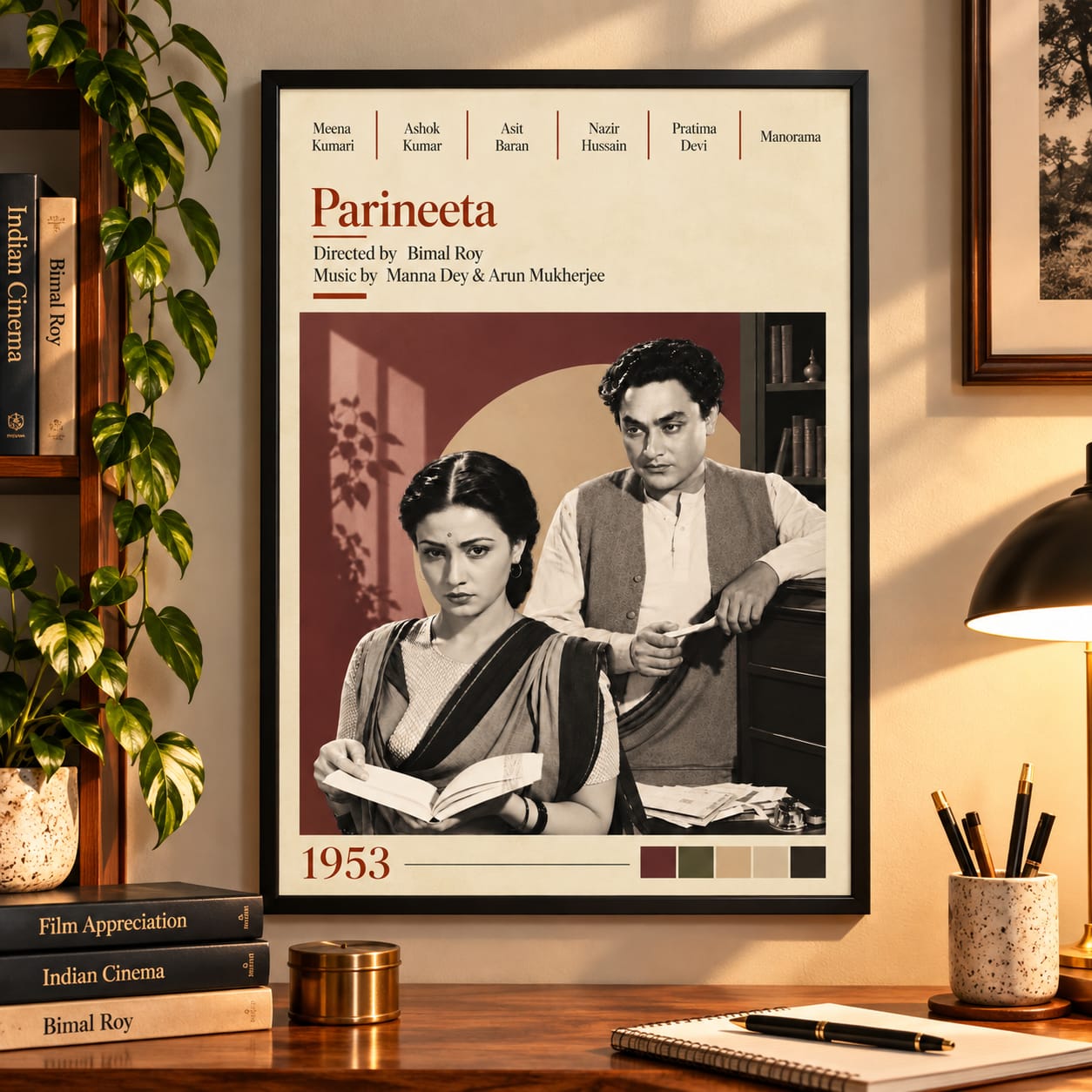
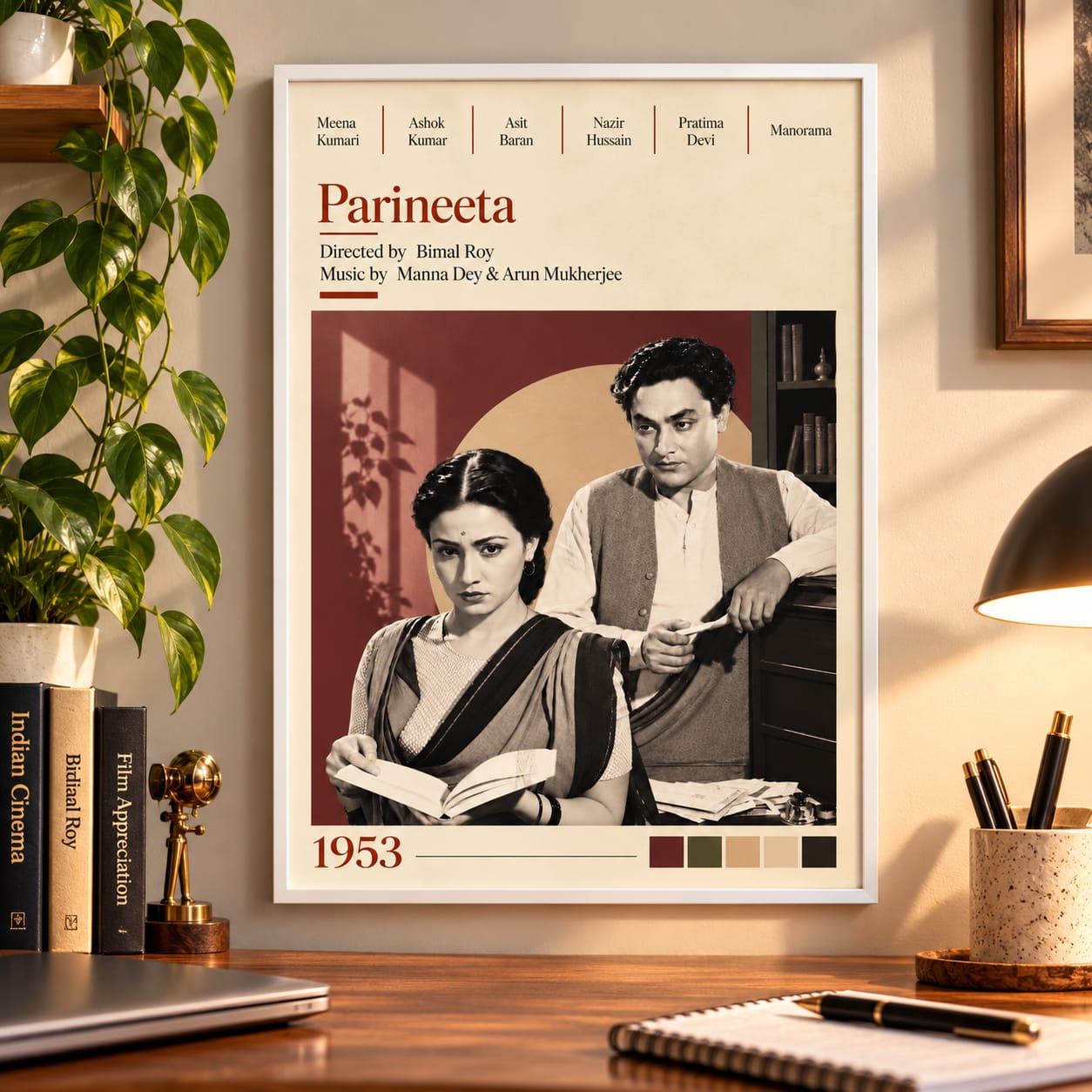
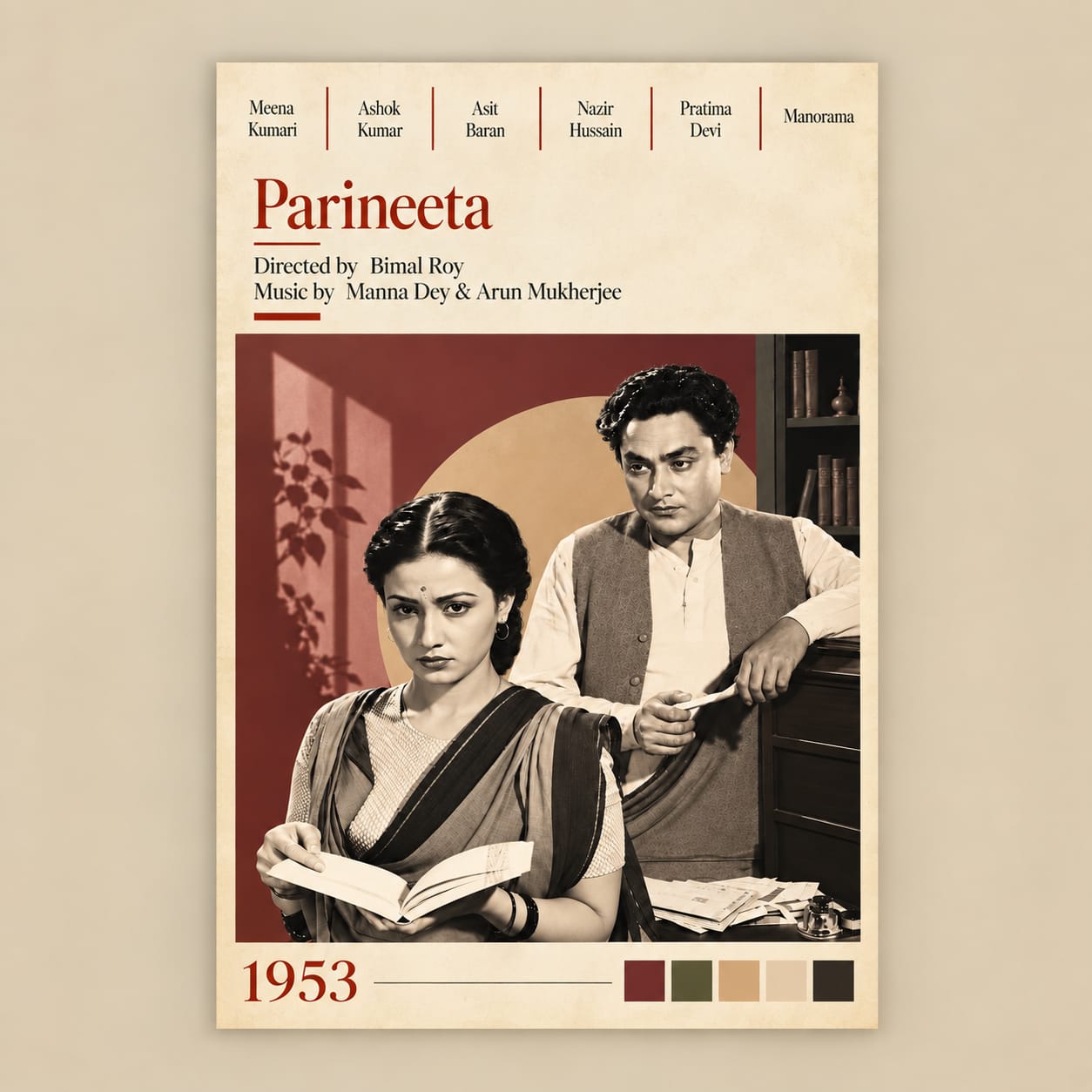
This contemporary reimagining of Bimal Roy’s Parineeta captures the film not through a grand romantic moment, but through the quiet emotional distance between two people who already belong deeply to one another. Lalita, played by Meena Kumari, sits in the foreground with an open book in her hands. She appears composed, yet her expression carries thoughtfulness and hurt. Behind her stands Shekhar, played by Ashok Kumar — physically close, but emotionally separated from her.
The composition reflects the restrained nature of their relationship. Their affection has grown through familiarity and everyday intimacy, but family debt, class difference, pride and misunderstanding gradually disturb that closeness. The muted maroon interior, old books and scattered papers evoke the educated Bengali household from which the story emerges, while the pale circular form behind the couple visually binds Lalita and Shekhar together even as their positions suggest a growing distance.
Artwork note: This is a contemporary artistic reimagining inspired by the film, not an original 1953 theatrical poster.
Lalita — Quiet Strength and Dignity
At the emotional centre of Parineeta is Lalita. Orphaned and living with her financially struggling uncle Gurucharan, she possesses little material security, yet she is never defined simply by poverty. Lalita has dignity, emotional strength and a profound sense of belonging. Her relationship with Shekhar has grown naturally through years of closeness between two neighbouring households.
Lalita loves Shekhar deeply, but she does not surrender her self-respect when suspicion and jealousy enter their relationship. Much of her pain remains internal. This quality inspired her position in the artwork: she holds an open book, yet her mind appears elsewhere. Her expression becomes that of a woman carrying love, responsibility and hurt without turning any of them into spectacle. Meena Kumari’s restrained performance gives Lalita both vulnerability and inner strength.
Shekhar — Love Complicated by Pride
Shekhar is a more conflicted figure. He comes from privilege, while Lalita belongs to a household burdened by debt. Yet their long familiarity has created an intimacy that crosses this economic divide. Shekhar genuinely loves Lalita, but his love becomes entangled with possessiveness, jealousy and pride.
When Girin enters the family’s life and offers help during Gurucharan’s financial difficulties, Shekhar begins to misread the situation. The possibility that Lalita may belong to someone else wounds his pride and feeds the misunderstanding between them. This is why the poster places Shekhar behind Lalita rather than beside her: he is close, he is watching her, and he remains emotionally connected to her — yet there is unmistakable distance.
Love, Pride and Misunderstanding
The central sadness of Parineeta is not that Lalita and Shekhar do not love each other. It is that love alone does not protect them from misunderstanding. Gurucharan’s financial difficulties make Lalita’s household vulnerable, while money and social position give others greater power over their circumstances. Girin’s generosity, rather than bringing only relief, becomes another source of suspicion.
Bimal Roy uses their romance to explore how money, class, family authority and wounded pride can enter even the most intimate relationships. The poster therefore avoids an obvious embrace. Lalita and Shekhar occupy the same room and the same emotional world, yet seem trapped inside separate thoughts. They are close, yet distant. They love, yet misunderstand. They belong deeply to one another, yet circumstances repeatedly make them question that belonging.
The Meaning Behind the Artwork
The open book in Lalita’s hands represents thought, education and an inner life that cannot easily be spoken aloud. The papers and letter-like sheet around Shekhar suggest communication, family affairs and misunderstandings. The bookshelf and domestic setting evoke the intimate Bengali world in which their relationship has grown, while the muted maroon and cream palette gives the composition the warmth of memory without losing the melancholy beneath the romance.
Most importantly, Lalita occupies the foreground. Although Parineeta is a love story, its emotional centre lies in the quiet dignity of a woman whose love is repeatedly tested by circumstances beyond her control.
They are close, yet distant. They love, yet misunderstand.
Customer Feedback
0 Reviews
No Reviews Yet
Have you used this product? Be the first to share your thoughts!
Have You Purchased This?
Please log in to your account to write a verified customer review.
Login to Review