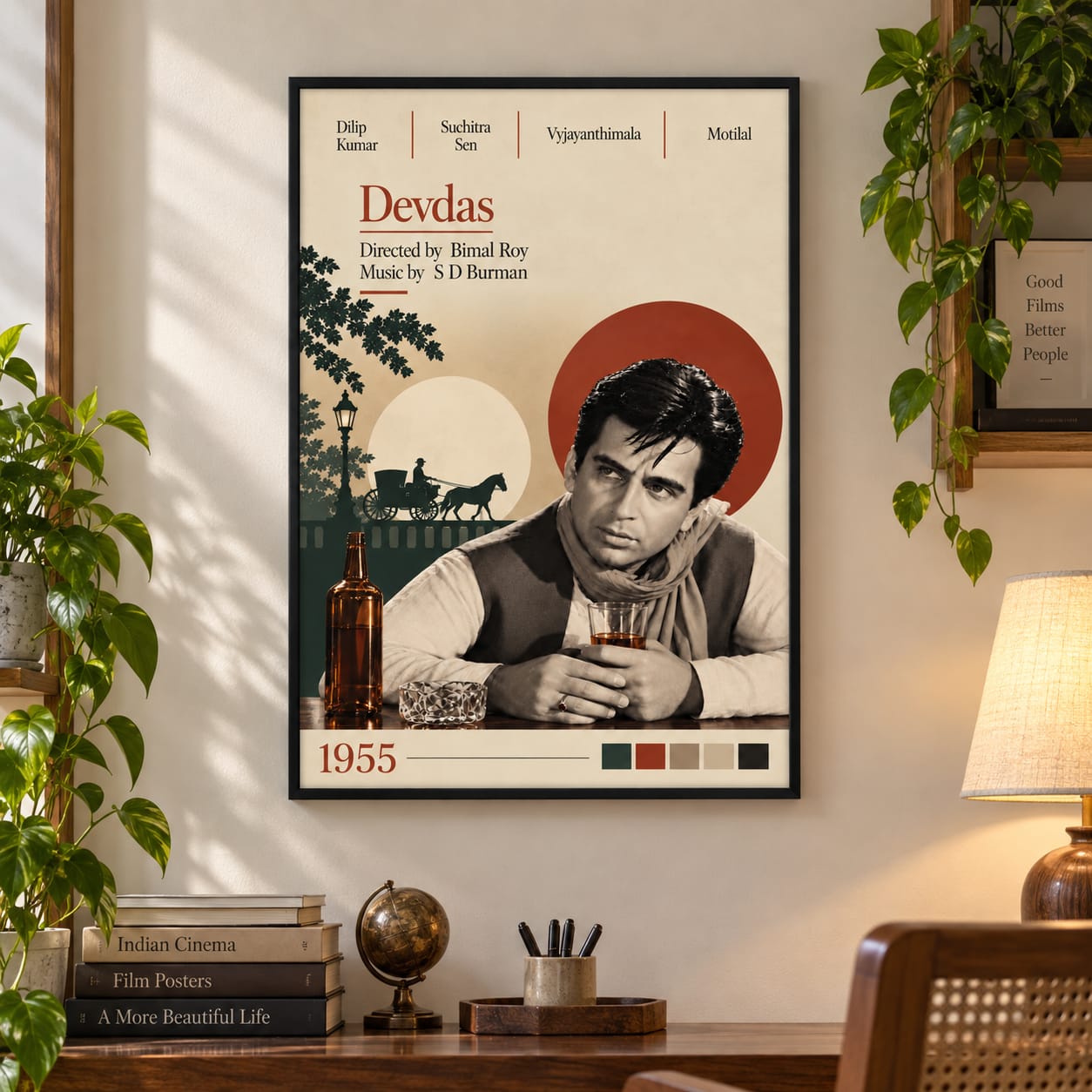
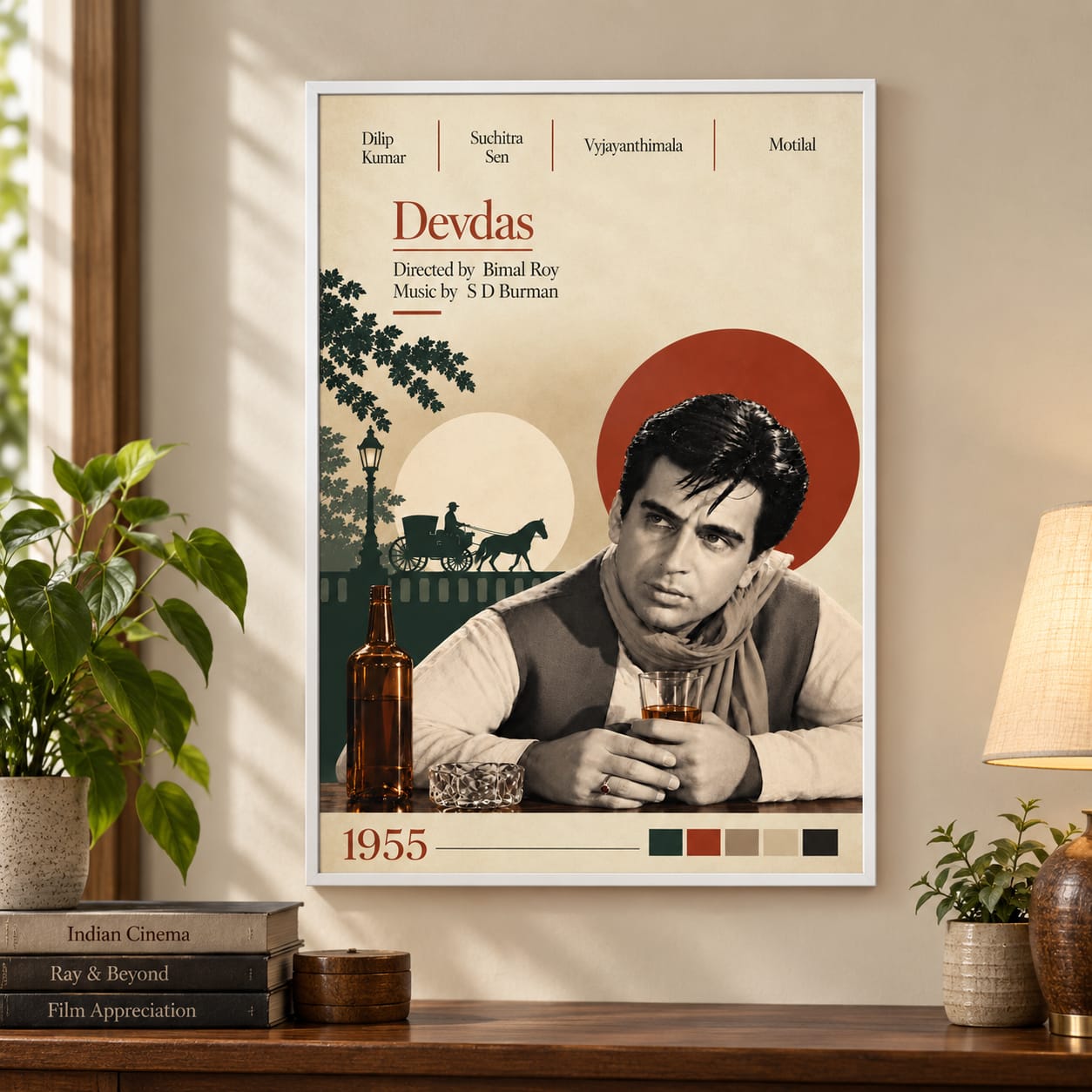
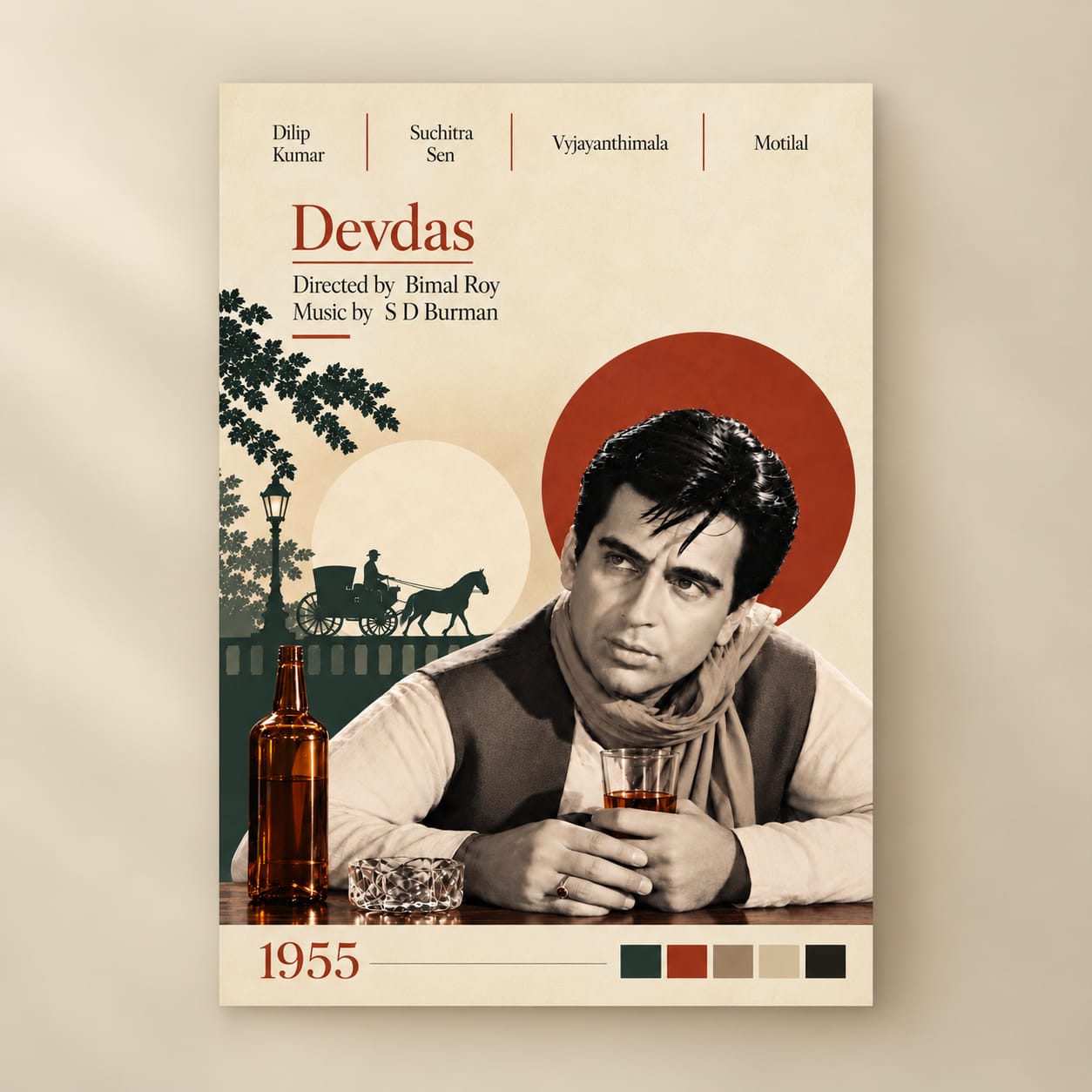
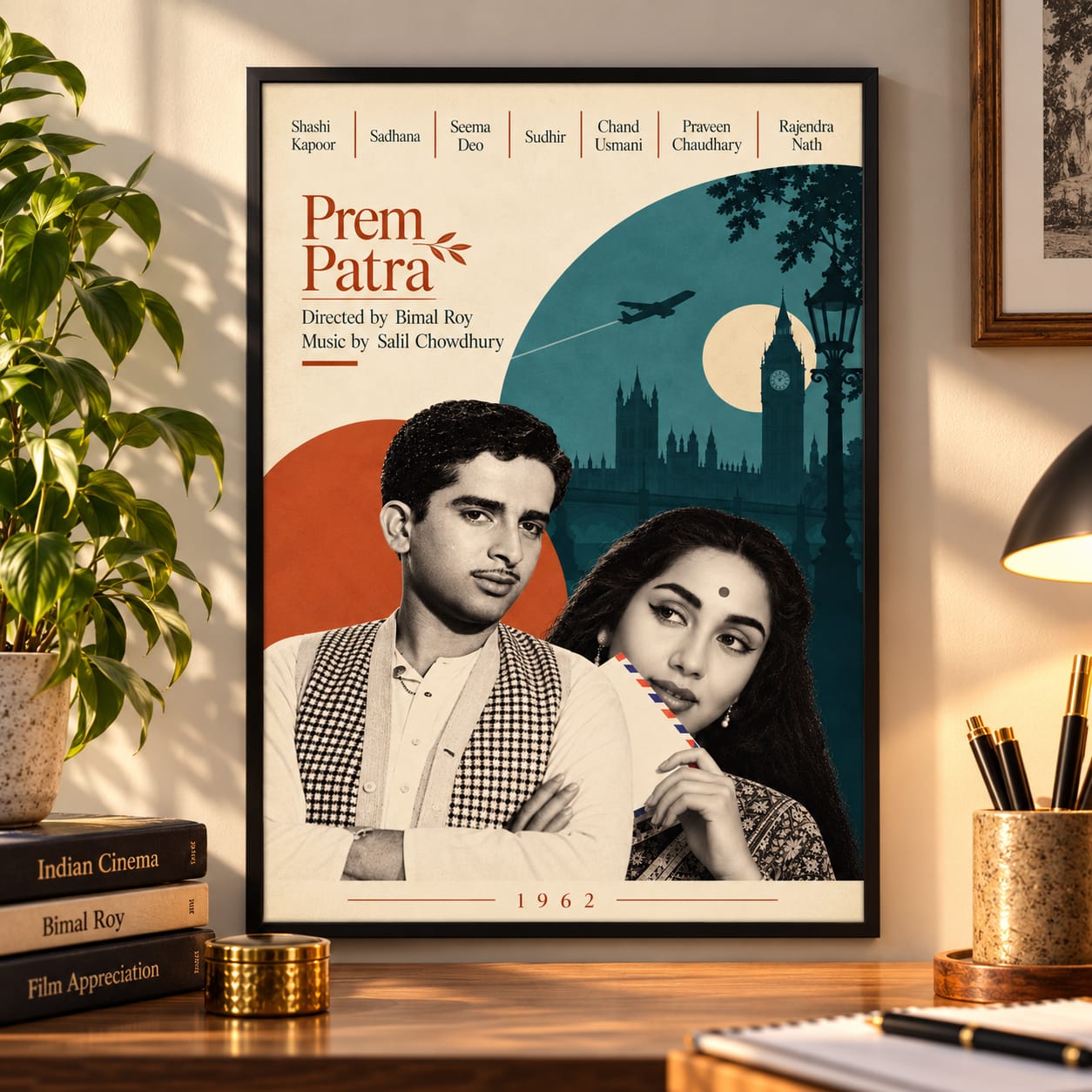
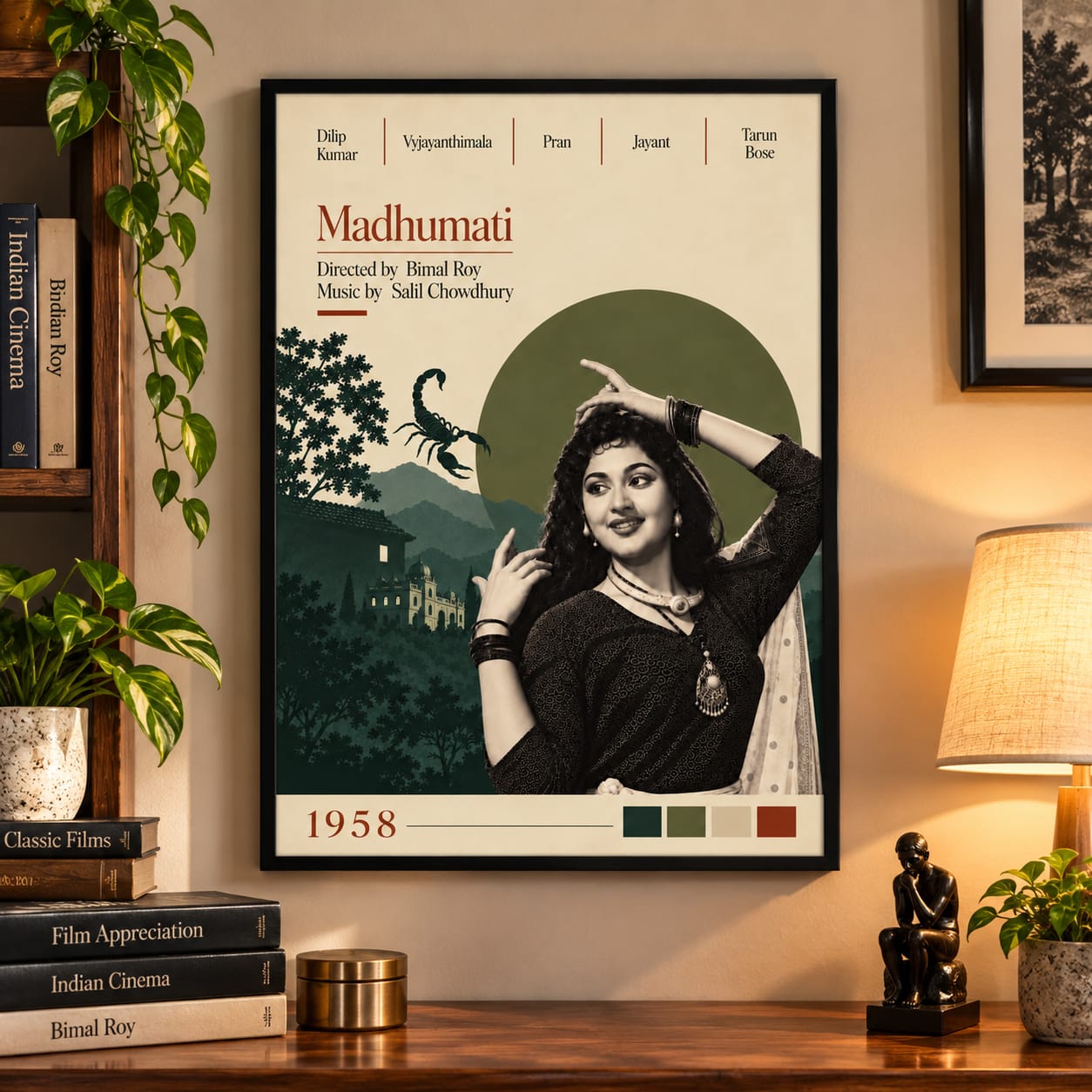
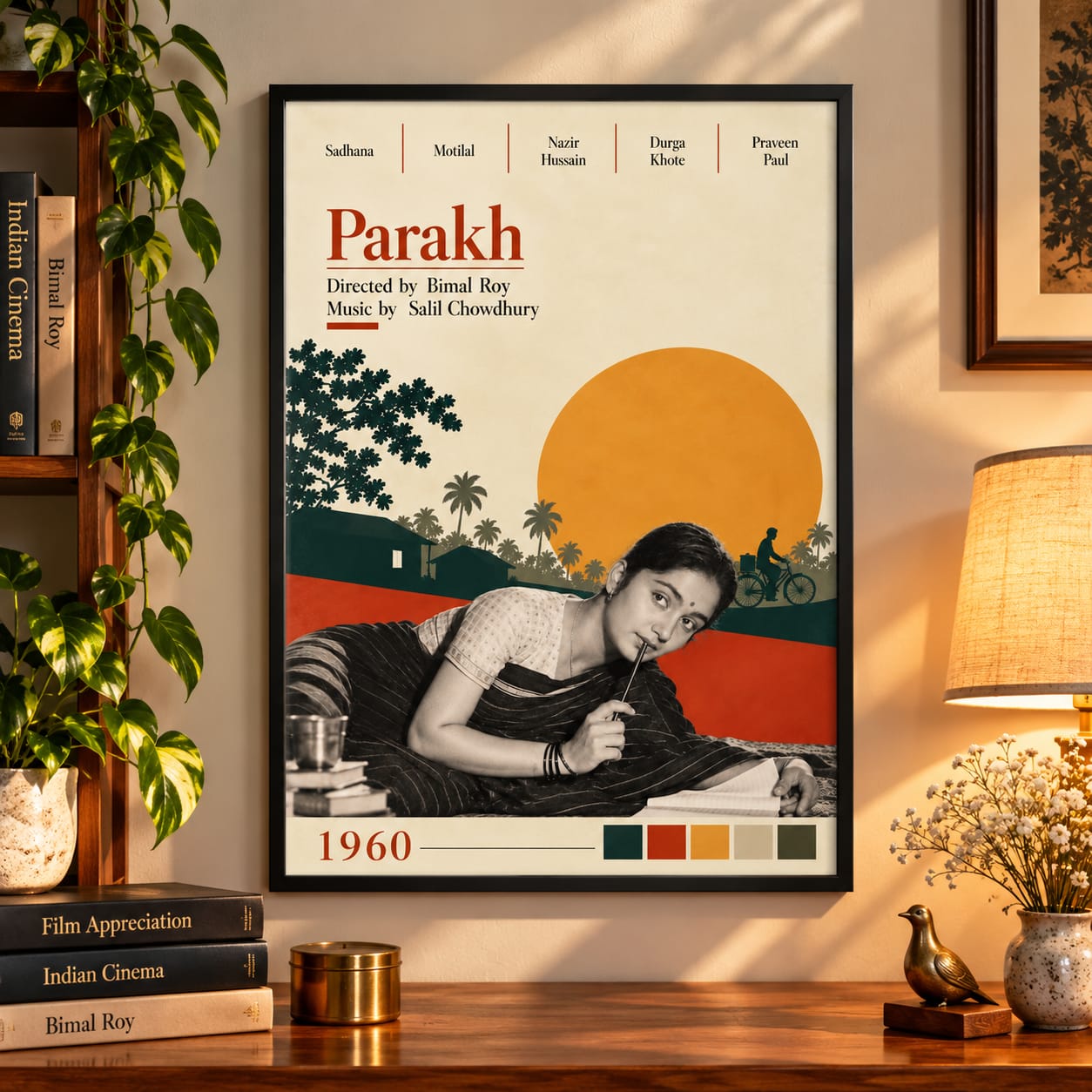
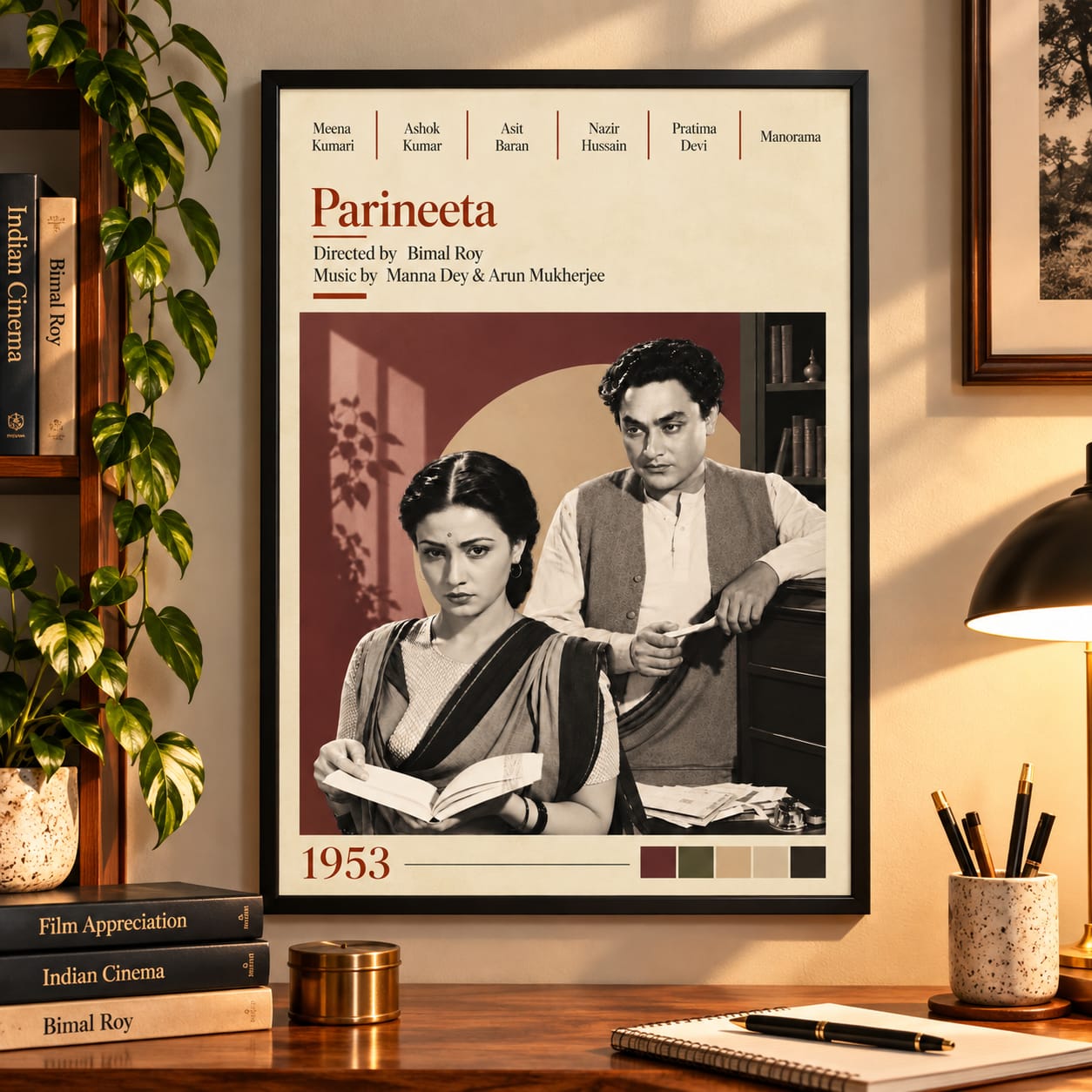
This contemporary reimagining of Bimal Roy’s 1955 Devdas places the character himself at the emotional centre of the composition. Dilip Kumar’s Devdas is shown in monochrome, leaning over a table with a glass held between his hands. Beside him sit a bottle and an ashtray. Nothing in the scene celebrates drinking; instead, these objects become quiet evidence of a man gradually withdrawing from the life around him.
The poster balances this intimate portrait with a restrained visual world of deep green silhouettes, a street lamp, foliage and a horse-drawn carriage. A pale circular form and a large rust-red disc create the feeling of memory hovering behind him. The warm cream ground gives the artwork the character of an aged print, while the rust, green and charcoal palette keeps it elegant, melancholic and distinctly mid-century.
A love remembered too late
Devdas and Parvati - Paro - grow up together, but their relationship is divided by family pride and social differences. When the moment comes for Devdas to stand firmly beside Paro, he hesitates. By the time he understands the depth of what he has lost, Paro’s life has moved in another direction. That delay - the space between feeling and action - is one of the central ideas behind this poster.
The glass is not glamour
The bottle and glass occupy the foreground deliberately. They are not decorative symbols of vintage sophistication. They represent Devdas’s retreat from grief. Unable to recover his relationship with Paro and unable to build a new emotional life, he increasingly turns to alcohol. The poster freezes him in that private interval: the world continues beyond him, but he remains seated with memory, regret and the glass.
The carriage and the road
The horse-drawn carriage in the distance introduces another recurring idea in Devdas: movement without emotional escape. Journeys separate people, bring Devdas back toward the past, and ultimately carry him toward the promise he once made to see Paro again. In the artwork the carriage remains small and distant, almost like a memory passing behind him.
Customer Feedback
0 Reviews
No Reviews Yet
Have you used this product? Be the first to share your thoughts!
Have You Purchased This?
Please log in to your account to write a verified customer review.
Login to Review